
The chef and restaurateur Tore Wretman, born in Stockholm in 1916, was one of the most influential figures in 20th-century Swedish cuisine. He trained at Maxim’s in Paris, learning the techniques of French cuisine, and then, from 1945 onwards, began applying them to traditional Swedish home cooking. Initially at the run-down Riche on Birger Jarlsgatan in Stockholm, which he renovated with partners. The Riche, originally opened in 1893 as a brasserie modelled on the Parisian Café Riche, quickly became one of the city’s most popular restaurants under Wretman and remains so to this day. He subsequently took over other establishments, including the Operakällaren and the Stallmästaregården, and is regarded as the person who first elevated Swedish gastronomy to continental standing.
Wretman is said to have invented the Toast Skagen in the late 1950s. The story he told himself goes like this: he was taking part in a regatta off the Danish peninsula of Skagen on his sailing yacht when he ran into a lull; he went below deck and whipped up an improvised snack from whatever he had on board. He carried the dish back on deck; someone asked what it was called, he looked towards the shore and named it Toast Skagen. Whether that is exactly how it happened cannot, of course, be proven. A few weeks later, it appeared on the menu at Riche, now refined with löjrom, the roe of the vendace from the waters around Kalix in Norrbotten, northern Sweden. This löjrom – pale golden-yellow, fine-grained, with a distinct taste of the sea – enjoys protected designation of origin in Sweden and is not a caviar substitute, but a product in its own right.
Here in Germany, you can find it in well-stocked delicatessens or online; but we simply opt for local trout roe, which you can buy in a good supermarket. It isn’t a particularly expensive product either. The main ingredient, however, is prawns – ideally small, pre-cooked and peeled North Atlantic prawns. We make sure to buy wild-caught prawns with an MSC label – these are the better ecological choice compared to farmed tropical prawns. Whilst the MSC label is not a universal guarantee of sustainability, it does at least confirm the authenticity of the claim that the prawns are wild-caught.

The rest is done in no time at all. Crème fraîche (we prefer a lighter version with less fat) and mayonnaise form the base. If you want to make your own mayonnaise, you’ll find the recipe here.
In any case, it is seasoned to taste with salt, white pepper, lemon juice and fresh dill. The original recipe apparently included mustard, and that’s a key ingredient for us too. We also like to add a small amount of grated horseradish, and a few dashes of Worcestershire sauce certainly don’t go amiss. However, this is optional and won’t feature in more traditional versions.
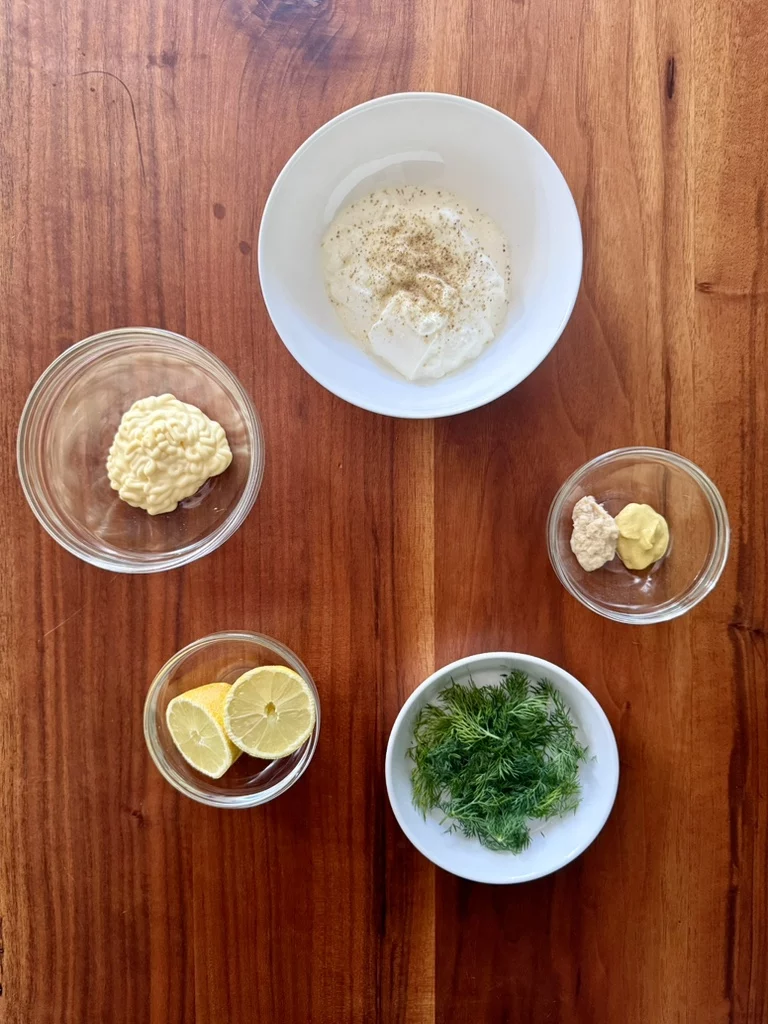
Mix everything together and season to taste. We’ve included the usual quantities at the end of the recipe, but these are just guidelines. Follow your own personal taste. Why not add some very finely chopped gherkins or capers? Or a tiny pinch of cayenne pepper?
Two tips on how to proceed:
Firstly, the prawns must be as dry as possible, as the aim is to create a firm mixture. Too much water would cause the mixture to run off the bread or make it soggy. So if the prawns aren’t dry, or if they’re even sitting in liquid, squeeze them firmly with your hands first.
Secondly, you shouldn’t add the prawns to the cream sauce; instead, do the exact opposite and gradually add the cream sauce to the prawns. This way, you can control how firm it becomes in the end and what the ratio of prawns to cream should be.
This mixture is called Skagenröra, named after the dish or the Danish peninsula, with ‘röra’ meaning ‘mixture’.
All that remains is to roast some toast or white bread, on both sides, with butter in a frying pan. We prefer white bread with a crispy crust.

Then it’s ready for serving. Spread a generous portion of Skagenröra onto the toast and garnish with more dill. You can serve it with a slice of lemon on the side, to add a little extra flavour after the first mouthful. Use a spoon to make a small hollow in the centre and place some caviar in it for a particularly delicious bite.
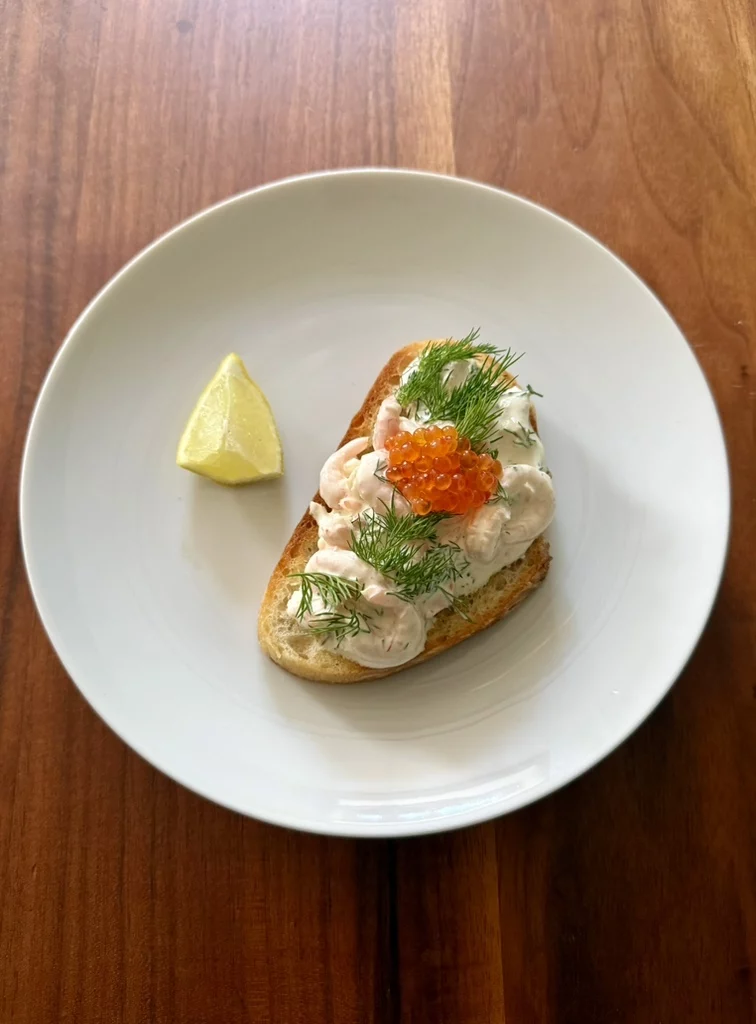
Enjoy.
And may the taste be with you.
Ingredients (for 4 people as a starter):
320 g prawns, peeled and cooked
4 tbsp mayonnaise
120 g crème fraîche (we use: low-fat, 15% fat)
2 tbsp chopped dill
Lemon juice to taste (we use: approx. ½ lemon)
Salt and white pepper to taste
Optional: 1 tsp Dijon mustard, ½ tsp grated horseradish and/or 2 dashes of Worcestershire sauce
4 tsp salmon or trout caviar
Toast or white bread, roasted with butter on both sides

One thought on “Toast Skagen”