
Whilst travelling through Laos – a country we highly recommend visiting – we came across curries known as ‘Susi’ about 100 km south of the Chinese border. We didn’t see them anywhere else in the country, though that may simply have been a coincidence.
We asked around, but nobody was able to give us an explanation of the name or its origin.
These dishes, made with chicken (‘kai’) or fish (‘pa’) or simply with vegetables, were not only delicious but also quite different from the coconut curries in Thailand. This was obviously down to the dill, but that wasn’t the only reason. So we spent a long time researching until we came across this recipe. It’s our own creation; to us, it tastes just like the original, but we don’t claim it is.
There are no dictionary entries for ‘Susi’, but the phonetic and culinary similarity to the Thai term ฉู่ฉี่ (chu chee) is striking. The name is said to derive from the sizzling sound produced when thick coconut cream is heated in an open pan until the coconut oil separates and the fried curry paste begins to sizzle in it. We have used this technique before.
First, you make a curry paste. For this, you’ll need dried chillies – deseeded and soaked in cold water – shallots, garlic, lemongrass, galangal, turmeric, prawn paste, kaffir lime leaves and salt.
That sounds like a lot, but it’s not really a problem at all. You can find all the ingredients in an Asian supermarket, and it doesn’t really matter which type of prawn paste you use. We just strongly advise against leaving it out. It’s just like with Nasi Goreng – without this key flavouring, it simply isn’t the same.
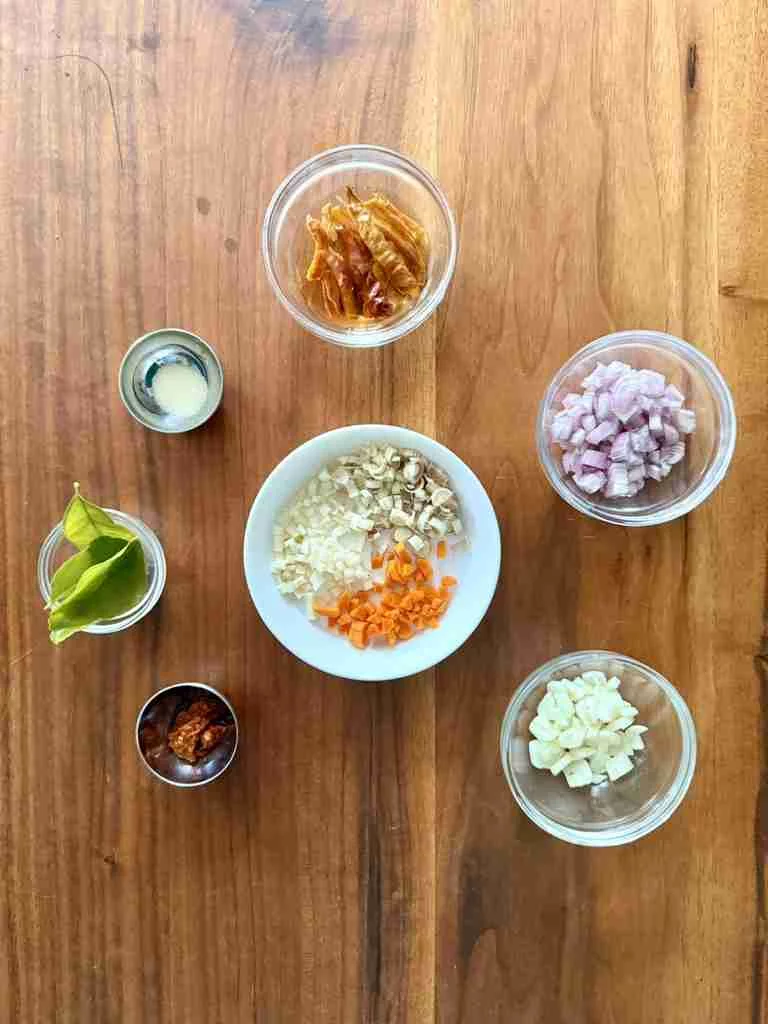
The paste is made in a mortar or a food processor. You’ll find many of our recipes for Thai curry pastes and tips on how to make them under the keyword ‘Thailand’. It freezes very well, so we always make a much larger batch straight away.
You could make this curry with all sorts of ingredients; today we’re using new potatoes, which we’ve par-cooked briefly in salted water, aubergine, which we’ve diced and lightly fried in a pan, bamboo shoots and shimeji mushrooms.

We also use a bit of chicken breast – hence the name ‘Susi Kai’ – but feel free to experiment. This dish can be made with a huge variety of ingredients.
First, fry the curry paste in a little oil in a hot wok for 30 seconds, stirring constantly, to bring out all its flavours.

Then add a small amount of coconut milk, about 10 per cent of the total quantity. With tinned coconut milk, a thick layer often settles on top; we use this at this stage. Alternatively, you can replace some of the coconut milk with thicker coconut cream and use that instead. This is cooked until the oil visibly separates. Only then is the rest of the coconut milk added.

After 5 minutes of gentle simmering, during which the flavours blend together, season to taste with palm sugar and fish sauce. As in Thai cuisine, this replaces the salt and adds an important flavour of its own. Keep tasting your curry and adjust the seasoning with sugar and fish sauce if necessary.
We’ll now cook the chicken in the coconut milk and reheat the pre-cooked potatoes in it at the same time. Then we’ll add the white part of the spring onions, finely sliced – we don’t want them raw in the curry.

Next come the soft vegetables, which hardly need any cooking time at all. In our case, aubergine, bamboo shoots and, last of all, mushrooms.

The green parts of the spring onions and roughly chopped dill are added just before serving. Basil of any kind has no place in this dish.

The result is sensational and, despite the many similarities, doesn’t remind you of Thailand at all. If you’re reading this and should know more about the dish, please do get in touch.

Enjoy.
And may the taste be with you.
Ingredients (for 4 people):
For the paste:
6 dried red chillies, deseeded, soaked in cold water for at least 15 minutes
½ tsp salt
2 tbsp shallots, roughly chopped
1 ½ tbsp garlic, roughly chopped
2 tbsp lemongrass, white pith only, chopped
1 tbsp galangal, peeled and chopped
1 tbsp fresh turmeric, chopped (or 1 tsp powder)
¼ – ½ tsp prawn paste
3 kaffir lime leaves, central vein removed
For the curry:
1 tbsp neutral vegetable oil for frying the paste
800 ml coconut milk (or 600 ml coconut milk and 200 ml thick coconut cream)
1 – 2 tbsp fish sauce
1 – 2 tsp palm sugar (or brown sugar)
As ingredients (examples):
400 g chicken breast or thigh meat, skinless
200 g aubergines
200 g potatoes
200 g mushrooms
120 g bamboo shoots, drained
The white part of 4 spring onions, finely chopped
To finish:
1 large bunch of dill, stalks removed, roughly plucked
The green part of 4 spring onions, finely chopped
Optional: a little sawtooth coriander, though this is hard to come by outside Asia
To serve:
Jasmine rice or sticky rice (in Laos, sticky rice is virtually the only type served)
