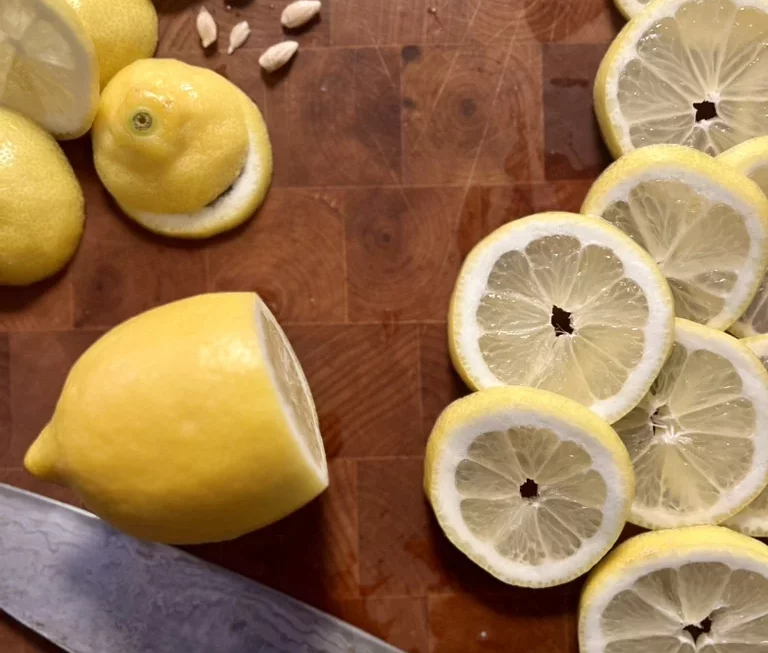
We love Moroccan cuisine and tagine in particular. We have already published recipes for this ingenious cooking technique, for example this one.
Indispensable ingredients in this cuisine are the spice mixture Ras el-Hanout, preserved lemons (also known as salted lemons), Harissa, which is a hot spice paste of Tunisian origin and Chermoula, a marinade that is widely used throughout Northern Africa.
We will explain the lemons today, Ras el-Hanout and Harissa (which you can of course also make yourself) perhaps another time.
Traditionally, very well-washed lemons are cut in half lengthways from the tip to the stem, but not all the way through, and this is repeated at an angle of 90 degrees so that the lemon is quartered but still holds together. Then the cut surfaces are rubbed with plenty of salt and pressed together again. The lemons are firmly packed into clean, tight jars and stored in a cool, dark place for a month.
You can easily find many recipes for this on the internet.
We would like to draw your attention to a lesser-known technique introduced by American chef Thomas Keller in 2011, which is particularly practical for the household because it allows you to make smaller quantities very quickly.
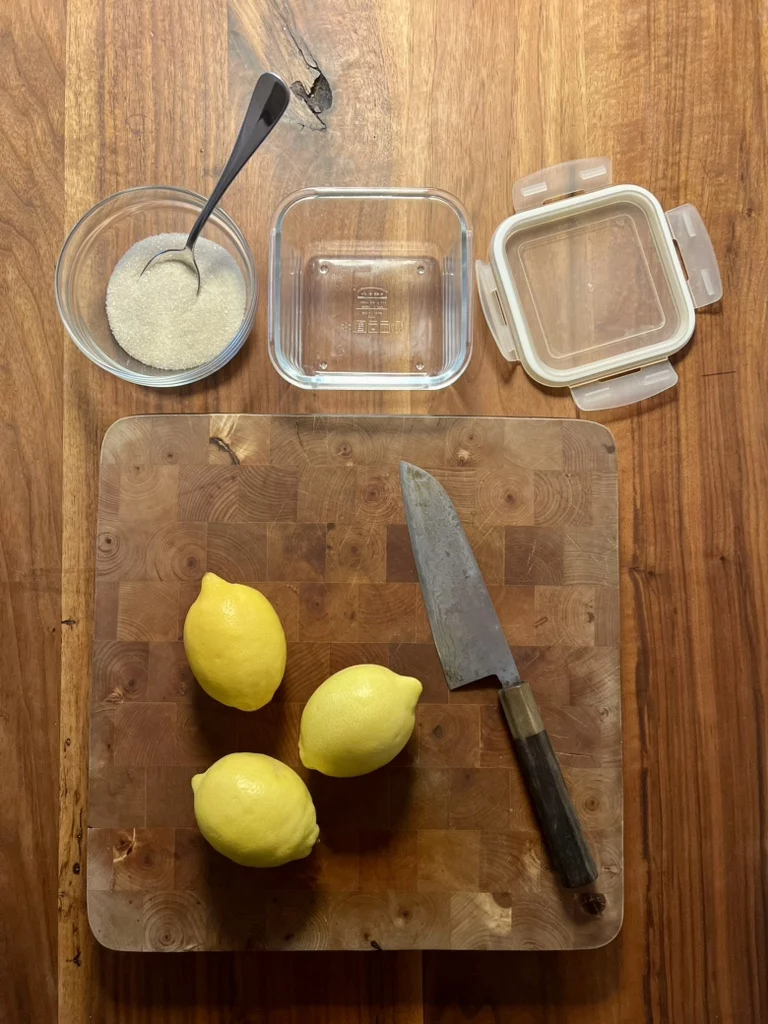
You need untreated lemons, i.e. with edible peel, which are first washed very thoroughly under hot water. We use a hard brush to remove any wax and other unwanted residues.
You also mix equal amounts of salt and sugar; as always, the quantities can be found at the end of this article. You may not need the whole amount of salt and sugar, this ultimately depends on the size of the lemons. And don’t be afraid of the sugar, it will break down in the further process and the lemons will taste as they should and not at all sweet. Think of it like using sugar in yeast dough.
After all, you need a sealable, translucent container.
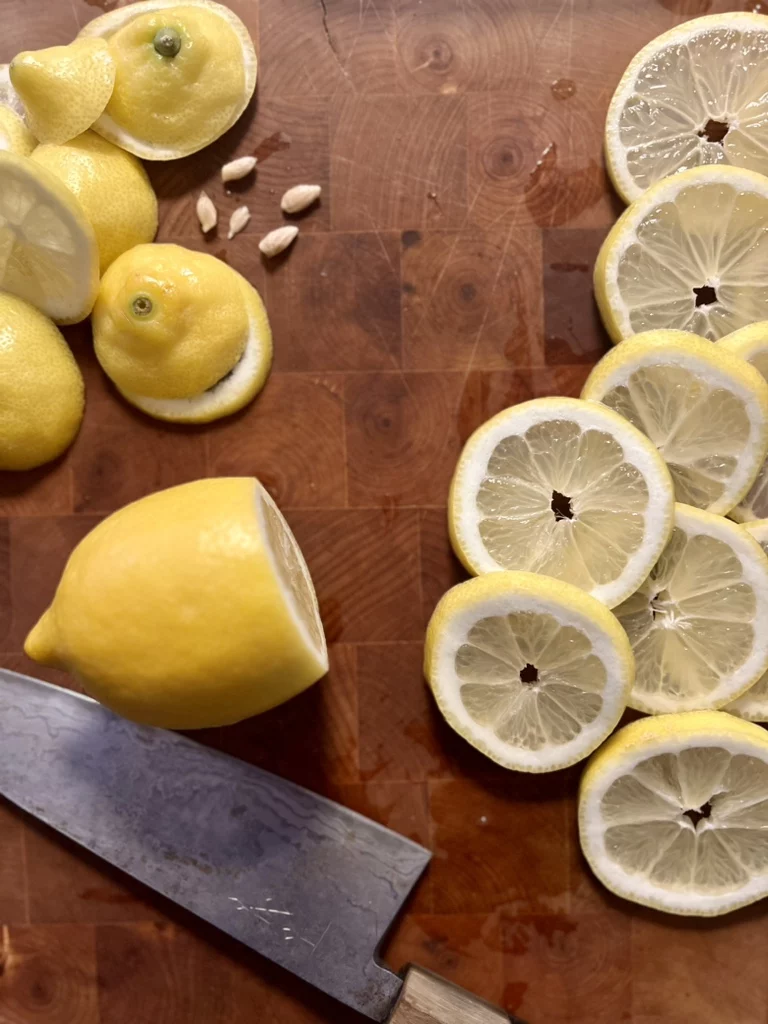
The lemons are cut crosswise into thin slices of 3 mm, 4 mm is also possible, 5 mm would be too much. You can then remove the seeds with the tip of the knife, which makes it easier to use them later. Only use the parts that have plenty of flesh, the end sections are not suitable.
The bottom of the container is completely covered with the salt and sugar mixture, then a first layer of lemon slices is placed on top. They can overlap a little, but should come into contact with as much of the salt and sugar as possible. This is followed by another layer of salt and sugar, another layer of lemon slices and so on. Finally, everything is covered once again with salt and sugar.
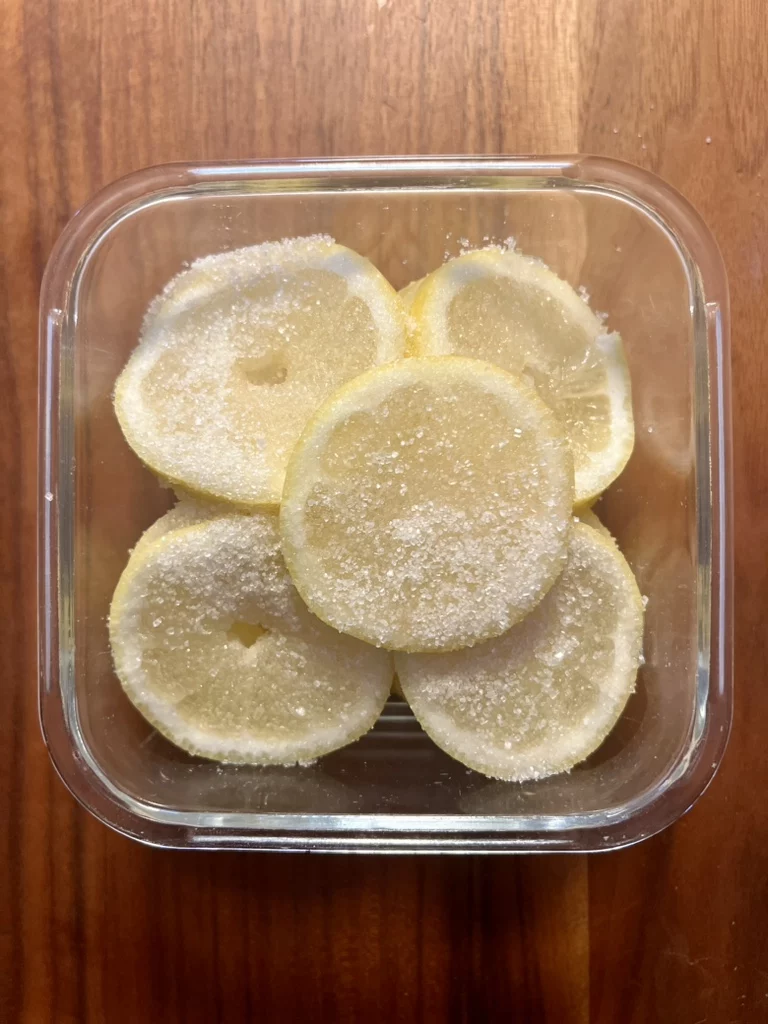
The container is sealed and placed in a bright, room temperature location, for example by a window. After less than 24 hours, an astonishing amount of lemon juice has leaked out and the slices are now immersed in it. We turn the container 360 degrees once a day without shaking it, so that all the slices remain in contact with the juice but are not jumbled up; they should lie flat on top of each other.
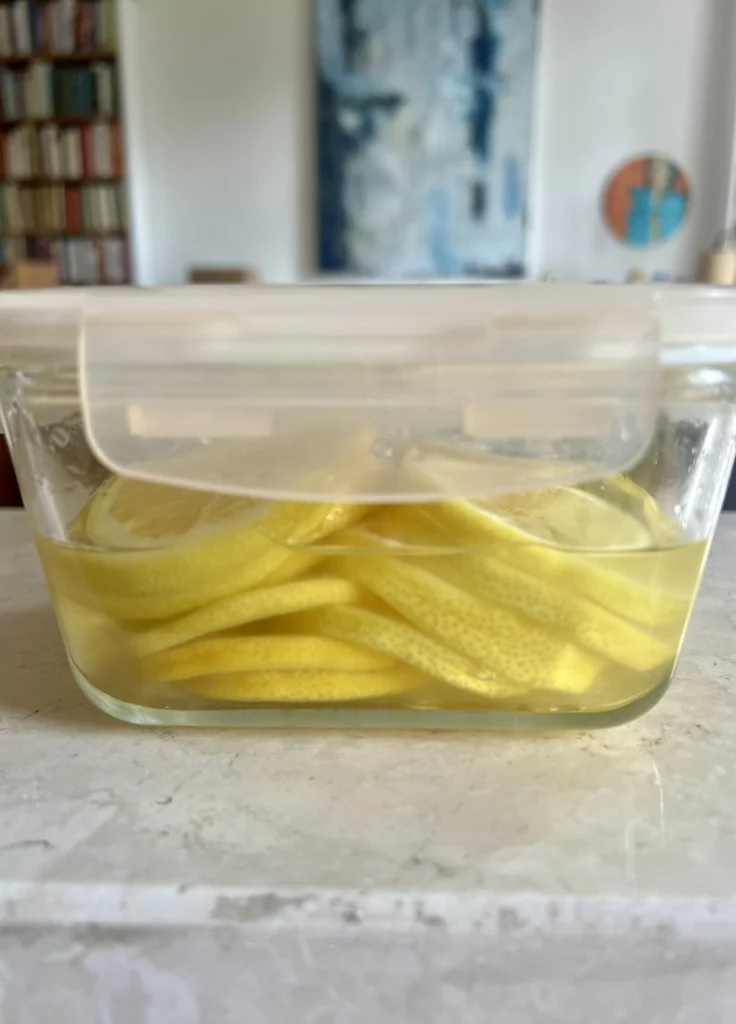
After 3 – 4 days, the juice will become thicker. Wait for this to happen, even if it takes a day or two longer. The preserved lemons are now ready to use. Transfer them to a jar with a lid that has been boiled beforehand so that it is perfectly clean. The slices should now be completely covered in juice. Squeeze them together a little and, if necessary, simply top up with more lemon juice.
Now store the jar in the fridge. The lemons will easily keep for several months. They will slowly darken, but that doesn’t matter and their flavour intensity will only increase.
Finely chopped, they are an absolutely delicious seasoning for many dishes and salads.
Enjoy.
And may the taste be with you.
Ingredients:
Organic lemons with edible peel, washed very well and hot
2 tbsp salt and 2 tbsp sugar per lemon, mixed

One thought on “Moroccan preserved lemons”