
There are dishes that have been so thoroughly trivialised that people have all but forgotten what they’re actually supposed to be. Guacamole is one of them. What comes out of packets these days – mixed with garlic powder and other nonsense, and often served straight away with industrial tortilla crisps – is, in its authentic form, a dish of remarkable depth and precision. And as you’ll see, there’s a lot you can get right, but also a lot you can get very wrong.
The name itself hints at its ancient history: ahuacamolli in Nahuatl, the language of the Aztecs – a combination of āhuacatl (avocado – but also, in fact, testicles) and molli (sauce). This gave rise to the Spanish aguacate for the avocado and mole for Mexican sauces. The Aztecs were already using avocados centuries before the Spanish conquest; evidence of their consumption is said to date back as far as an incredible 10,000 years. Guacamole was a dish in its own right, reflecting the richness of Mesoamerican cuisine: fat, acidity, heat and freshness in perfect balance.
The Spaniards who arrived in the Aztec Empire with Hernán Cortés were amazed by the buttery-soft fruit and the ways in which it was prepared, and subsequently spread it throughout the world.
Avocado – Variety and ripeness
Not every avocado is equally suitable for guacamole. The most common variety in Europe and North America is the Hass – developed by Rudolph Hass in California in the 1920s and now the dominant variety worldwide. Its skin is thick and leathery, its flesh creamy, rich in fat and nutty in flavour. It is precisely this high fat content that makes it the superior choice for guacamole: it carries the flavour, provides texture and binds the other ingredients together.
The Fuerte – smooth-skinned, pear-shaped, with milder, juicier flesh – is the main alternative. Widely grown in Spain, Israel and parts of Latin America, it is perfectly suitable for guacamole when perfectly ripe. The result will be slightly lighter and less creamy. Other smooth-skinned varieties are less suitable.
You can reliably tell how ripe an avocado is by looking at the stalk and the colour of the skin. As it ripens, the skin changes from green to dark brown and finally to almost black. The key is the stalk: if it comes away with a light press of the finger and reveals green flesh underneath, the avocado is ready. If it is brown, it is overripe. If the stalk is firm, it needs more time.

The common ‘pressure test’ – pressing the skin with your thumb – is, however, not only unreliable but also inconsiderate: the pressure leaves a bruised, dark mark in the flesh directly beneath the skin, which only becomes visible when the fruit is cut open, much to the annoyance of those who bought the avocado later – so please don’t do that!
Unripe avocados continue to ripen at room temperature. Placing bananas or apples nearby speeds up the process – the ethylene released by these fruits acts as a natural ripening agent. Refrigeration, on the other hand, significantly slows down the ripening process.
Chili – Serrano
There is a huge variety of very different types of chilli, particularly in Mexico.
Here in the picture, you can see, starting from the top left and going clockwise:

A poblano, green and medium-sized. With a heat level of 1,000–1,500 Scoville units, this variety is quite mild. When dried, it becomes an ancho chilli.
A Fresno chilli, bright red and of a similar size. With a heat level of 2,500–10,000 Scoville units, it is about as hot as a jalapeño.
A Serrano chilli, slender and green. This variety packs a punch of 10,000–23,000 Scoville units, which is just right for guacamole. If you’re worried, use a smaller one, just a portion of it, or remove the seeds. Green Serranos are fruits harvested while unripe; red Serranos are the same pods that have been left on the bush for longer (and become significantly milder as a result).
A habanero comes in many colours, and we’re talking about 100,000–350,000 Scoville units – far more than, say, Asian bird’s eye chillies. So Serranos aren’t actually that scary 😉
The only other ingredients you need are salt, onion, coriander, lime and tomato.

There’s no place for other ingredients in guacamole; in particular, there should be no garlic or cumin in it, and adding mayonnaise is a crime.
Finely chop the Serrano and onions. If you like, you can first halve the chilli lengthways and scrape out the seeds, which provide quite some heat. We don’t do this, as the chilli’s kick is a key element of a good guacamole. The avocado can easily balance this out.

Fresh tomatoes are an essential ingredient in guacamole. They add fruitiness and freshness, but shouldn’t overpower the dish, so use them sparingly. As we don’t want the guacamole to become watery, we remove the seeds and, most importantly, the jelly surrounding them. The flesh, including the skin, is diced into cubes of about 5 mm.
Hold the avocado by the thicker end in one hand and, with the other, insert a knife lengthways down the centre until you reach the stone.
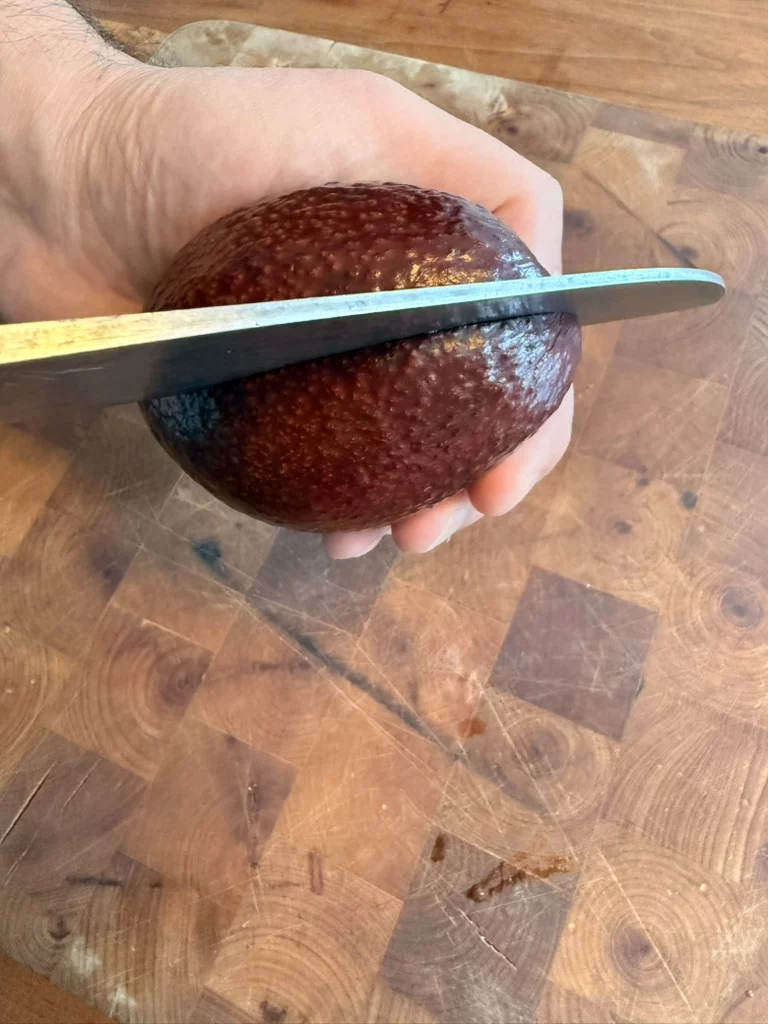
Instead of moving the knife, simply rotate the avocado in a circle, keeping the knife in contact with the stone at all times. This way, you won’t cut yourself. If you then gently twist the two halves of the fruit against each other, they will separate very easily.
One half contains the core. Simply tap the knife blade against it with just a little momentum, so that it makes a small notch…

…and gently twist the knife against the fruit – this way the stone comes away easily, staying on the knife.
Using a small knife, score the flesh of both halves in a criss-cross pattern into pieces about 5 mm thick; this makes it very easy to scoop out with a tablespoon.

Molcajete – the mortar as a method
A proper guacamole is made in a molcajete, the traditional Mexican mortar made from volcanic rock. The rough, porous surface of the mortar breaks down the cell structures of the chilli, coriander and onion in a way that no other tool can replicate – the difference in texture and flavour is enormous.
Any mortar will do, and if you enjoy cooking regularly, we strongly recommend investing in a decent, large stone mortar. It’s not a major expense. Alternatively, you’ll have to chop the ingredients with a knife and mash them with a fork; we strongly advise against using a blender.
The order is crucial: first, pound the chillies and onions with a pinch of salt to form a coarse paste…
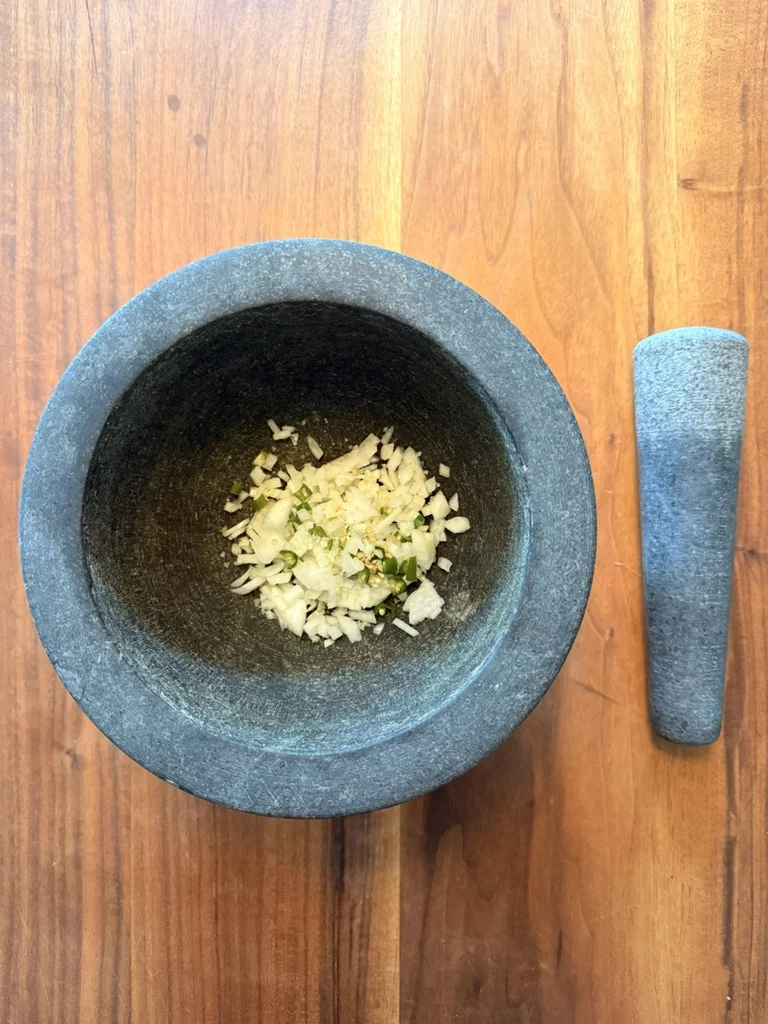
…then add the coriander and lime juice. Wash the coriander and roughly chop it, including the stalks. You can set a little aside for garnishing later. Roll the lime a few times over the tabletop with the palm of your hand, applying firm pressure, to help the juice come out more easily. To start with, use the juice of just one half, as you can always add more seasoning later.
And just like that, in a matter of minutes, a wonderfully fragrant, aromatic spice paste has been created.
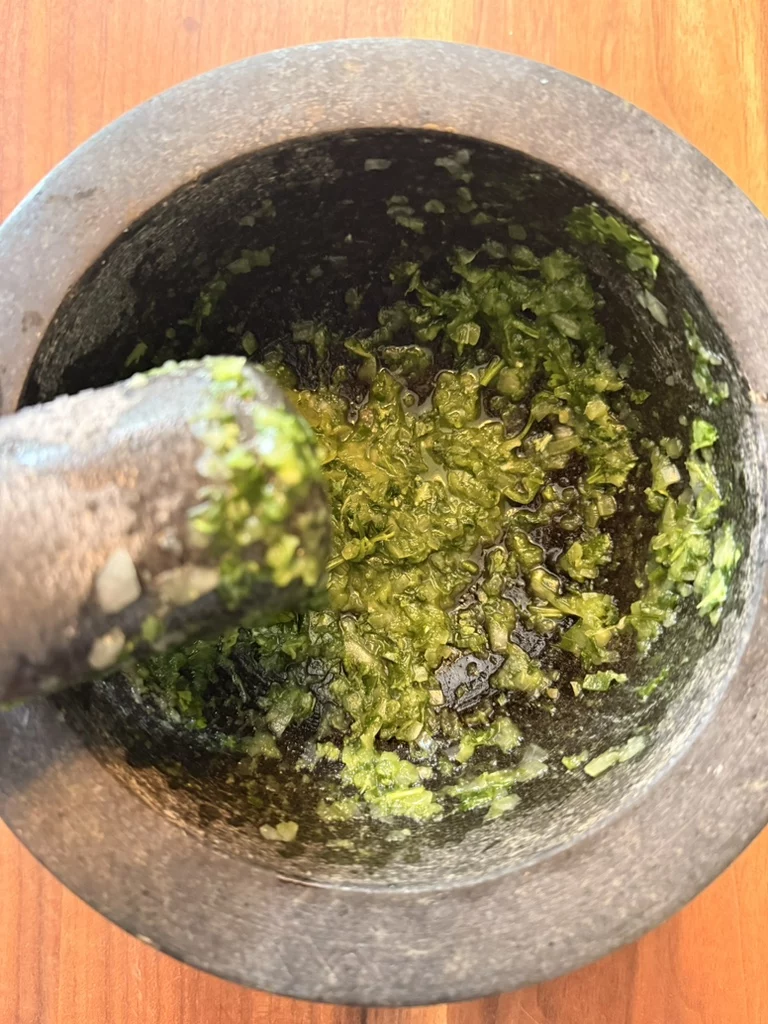
Now add the avocado pieces; mash them very lightly, ensuring the mixture remains chunky – guacamole isn’t a purée. Finally, season to taste with salt and lime juice, using both sparingly. Once everything is just right, stir in the tomato pieces right at the end.
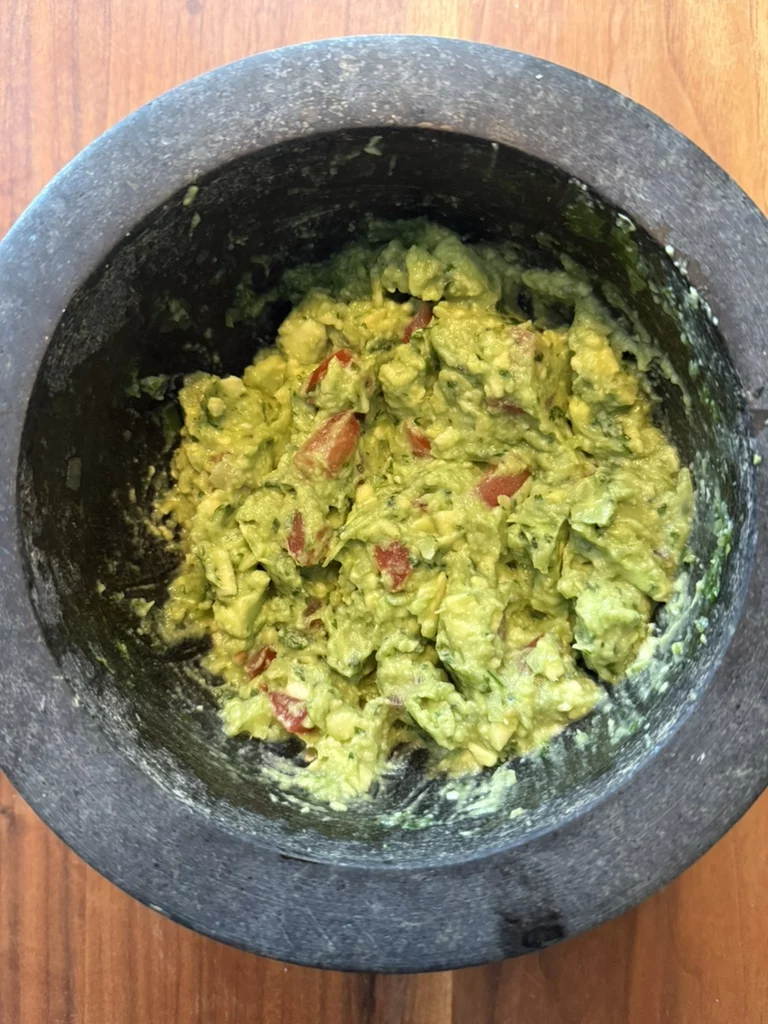
Whether you like avocado or Mexican cuisine or not, the result is undeniably an incredibly complex and elegant experience.

Enjoy.
And may the taste be with you.
Ingredients (for 2 generous portions or 4 people as a starter / dip):
2 very ripe avocado (variety Hass)
½ small onion
1 serrano cilli
1 pinch of course sea salt
10 – 15 g cilantro, leaves and stems
Juice of ½ – 1 lime
½ ripe tomatoe

One thought on “Guacamole”